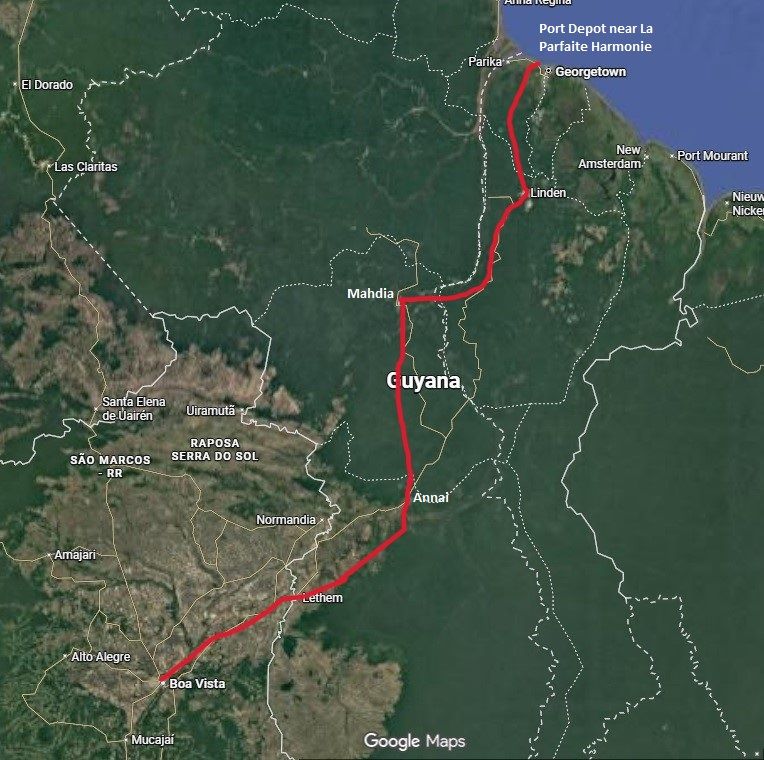
For decades, Guyana has spoken about linking its vast interior to the coast in a deliberate, efficient, and future-facing way. A proposed cross-border rail system connecting northern Brazil to Guyana’s West Coast forces that conversation out of theory and into uncomfortable relevance.
The concept is straightforward and ambitious. A continuous railway would run from Boa Vista in southern Brazil to a new rail depot and yard near La Parfaite Harmonie on the West Coast Demerara. Along the way, the line would integrate deep-water port access on both the Essequibo and Demerara Rivers, creating a direct land-and-river corridor between Brazil’s interior and Atlantic shipping routes.
On paper, this is bold. In practice, it challenges how Guyana has historically developed. We have built roads that stop short of opportunity, ports that choke on congestion, and interior regions that remain expensive to serve and easy to ignore.
Boa Vista, as the international rail origin, makes economic sense. It already ties into Brazil’s northern road and logistics network. Rail would offer a cheaper, safer alternative to long-haul trucking for freight and passengers moving north. At the Brazil-Guyana border, a purpose-built customs and security zone integrated into rail operations could replace today’s patchwork of delays and informal workarounds with a predictable, enforceable system.
Lethem’s proposed evolution into a Border Logistics City may be the most overdue idea in the entire plan. For years, Lethem has functioned as a pressure point rather than a gateway. Container yards, bonded storage, fuel facilities, and passenger terminals would finally treat the border as an economic asset instead of an inconvenience.
Further north, stops at Annai would matter less for grand trade flows and more for daily life. Agricultural producers in the South Rupununi need reliable access to markets. Communities need dependable passenger transport. Rail does not solve every problem, but it lowers costs and raises options.
Kurupukari highlights a more profound truth. Infrastructure creates settlements whether we plan for them or not. A proposed Kurupukari Transit Village for rail operations, emergency services, and intermodal transfer acknowledges that reality and seeks to manage it rather than pretending it will not happen.
Mahdia’s inclusion exposes how inefficient our current system is. Mining depends heavily on air transport and punishing interior trucking routes. Rail access would not only reduce costs but also improve safety and supply stability. That matters in a sector where accidents and shortages are routine rather than exceptional.
Linden’s role as the primary inland rail hub is both logical and symbolic. A Linden Rail Industrial Park with maintenance yards, container sorting, fabrication, and energy-linked industry could restore the town’s historic purpose as a transport and industrial center. Using or closely following the existing trail between Linden, Wismar, and Wales limits unnecessary land disturbance and avoids repeating past planning mistakes.
A new bridge across the Demerara River from Soesdyke may be the quiet game changer. Direct rail and road links to Cheddi Jagan International Airport would allow air-rail freight transfers that Guyana currently lacks. Shifting cargo and passenger traffic away from the East Bank Road would relieve a congestion problem that has been discussed endlessly and never solved.
At the coast, a terminus near La Parfaite Harmonie, with extensions to deep-water ports at Parika and Windsor Forest, would finally give Guyana an option that bypasses Georgetown rather than forcing everything through it. That alone should command attention.
None of this is cheap. None of it is simple. Financing, environmental impact, land use, and governance will all test the country’s maturity. Big projects have a habit of becoming monuments to waste when oversight fails, and timelines drift.
Still, dismissing the idea because it is hard would be the easiest mistake of all. Guyana is entering a period where oil revenue gives it choices. The real question is whether those choices will reinforce old bottlenecks or build new pathways.
If approached with discipline, transparency, and public accountability, a Boa Vista-to-West Coast rail system could change how Guyana connects its interior to the world. If handled casually, it will become another glossy proposal that never leaves the page. The difference will not be engineering. It will be political will and public scrutiny.