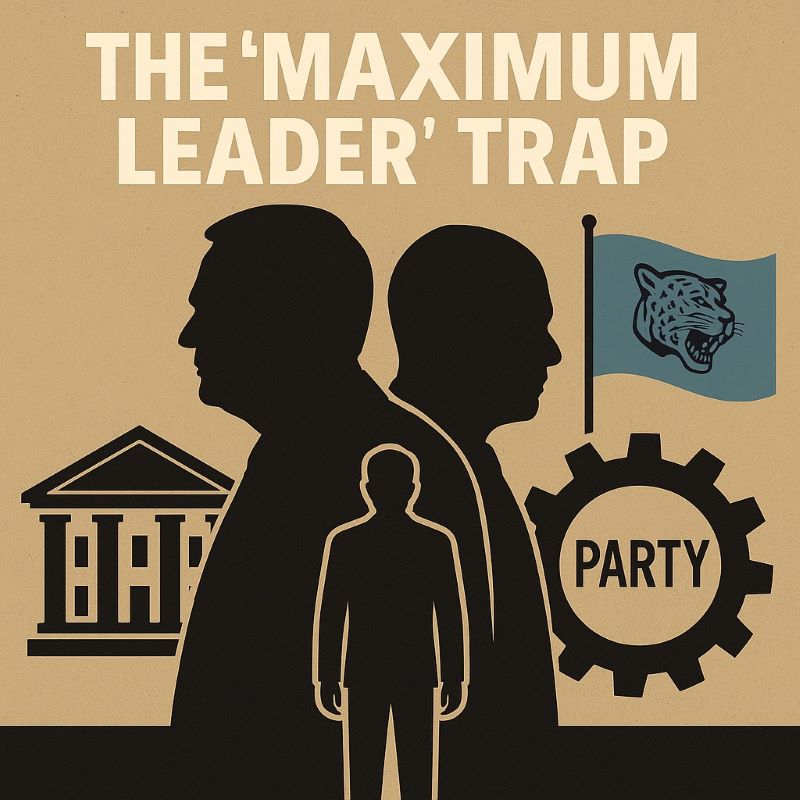
Across democracies, both emerging and established, a troubling political pattern has taken root: the elevation of political leaders to near-mythic status, long after their effectiveness has waned. This phenomenon, often referred to as the “Maximum Leader” model, undermines internal party renewal, stifles democratic evolution, and ultimately damages national progress. From Georgetown to Washington, the dangers of political inertia and leader-worship are proving costly.
At its core, the “Maximum Leader” theory describes a political environment where one individual’s grip on power becomes so entrenched that reform, accountability, or rejuvenation becomes nearly impossible. Party structures solidify around personalities rather than policies. Strategic paralysis ensues. And democracy suffers.
Guyana’s APNU and the Granger Era Hangover.
Guyana’s political history is shaped as much by personalities as by policies. Following the contentious 2020 general and regional elections, the APNU-AFC coalition offered a stark illustration of the dangers of loyalty without introspection.
Despite mounting local and international criticism of the electoral process and growing public disillusionment, the coalition remained closely tied to former President David Granger. Instead of using electoral defeat as an opportunity for reinvention, APNU entrenched itself in a posture of denial and defensiveness. Loyalty to Granger overshadowed strategic renewal, even as public confidence in his leadership, marked by policy stagnation and indecision, continued to erode.
The coalition’s refusal to elevate a new, dynamic leader or reimagine its political identity left it trapped in the past, unable to evolve with the electorate. The result: a fractured base, declining relevance, and a missed opportunity to serve as a meaningful counterweight to the ruling PPP.
Yet there is a glimmer of hope. The rise of Aubrey Norton as APNU’s new leader presented a chance to break from the past and redefine the party’s role. But success will not come from symbolic change alone. It requires bold investment in leadership development, broader inclusion, and a return to issue-based politics over personality cults. The Granger era must give way to a movement that is resilient, reform-minded, and ready for 21st-century governance.
Guyana’s PPP and Jagdeo’s Dominant Presence
While APNU grapples with its past, the People’s Progressive Party (PPP) continues to operate in the long shadow of Bharrat Jagdeo. Since assuming the presidency in 1999, and long after officially leaving office in 2011, Jagdeo has remained the undisputed power center of the PPP. His grip on the party has outlasted presidencies, outpaced internal rivals, and outshone the sitting president in influence.
Jagdeo’s brand of leadership is one of centralization and control. He frames the national narrative, sets the agenda, and silences dissent within the party ranks. Policy debates are reduced to a tired binary: PPP success versus opposition failure. Innovation and internal democracy are sidelined in favor of compliance and loyalty.
This excessive dependence on one man, rather than a system of strong institutions and collective leadership, has weakened the PPP’s internal structure and tarnished its external credibility. Allegations of corruption, cronyism, and politicized governance have marred Jagdeo’s tenure. As international scrutiny intensifies and close associates fall under investigation, the risks to the party and Guyana’s democratic reputation multiply.
The danger of the “Maximum Leader” is that when the leader falters, the entire structure falters with them. For the PPP, the challenge now is to reorient itself toward democratic norms and cultivate a leadership ethos that prioritizes merit over loyalty, transparency over control.
United States: Loyalty over Renewal in Both Major Parties
Guyana is not alone in grappling with the consequences of entrenched leadership. In the United States, both major parties exhibit symptoms of the “Maximum Leader” syndrome.
On the Democratic side, President Joe Biden’s decision to seek a second term despite concerns about age, stamina, and strategic messaging revealed a troubling reluctance within the party to confront hard truths. The lack of internal contestation and the suppression of alternative leadership voices narrowed the party’s flexibility and alienated key voter blocs, especially the young and independent.
Across the aisle, the Republican Party remains firmly in the grip of Donald Trump. Despite a presidency riddled with scandal, democratic backsliding, and a chaotic COVID-19 response, Trump continues to define the party’s identity. Primary challengers in 2024 were swiftly marginalized, as the GOP chose loyalty to Trump’s brand over introspective reckoning with his divisive legacy. The result is a party trapped in its echo chamber, unable to evolve beyond one man’s ambitions.
Why This Matters: The Global Cost of Political Stagnation
When political parties prioritize loyalty to a single leader over democratic renewal, the consequences go beyond internal dysfunction. Voter cynicism rises. Civic engagement declines. Institutions weaken. The gap between government and governed grows perilously wide.
In Guyana, where democratic norms are still developing, the refusal to refresh leadership in both the current administration and the opposition hampers national progress. It sends a damaging message: that power belongs not to the people, but to those who hold it longest and shout the loudest.
The Way Forward
Authentic leadership is not measured by how long one clings to power, but by how well one prepares others to lead. Political organizations must be brave enough to confront their failures, embrace reform, and invest in the next generation of leaders. That means opening internal spaces for competition, encouraging diverse voices, and retiring the myth that any one person is indispensable.
Whether APNU, PPP, Democrats, or Republicans, the lesson is clear: no leader is bigger than the people they serve. If parties continue to let personal loyalty trump performance and public interest, they risk becoming irrelevant footnotes in the very histories they hoped to shape.
The time for self-preservation must end. The time for national transformation must begin.